
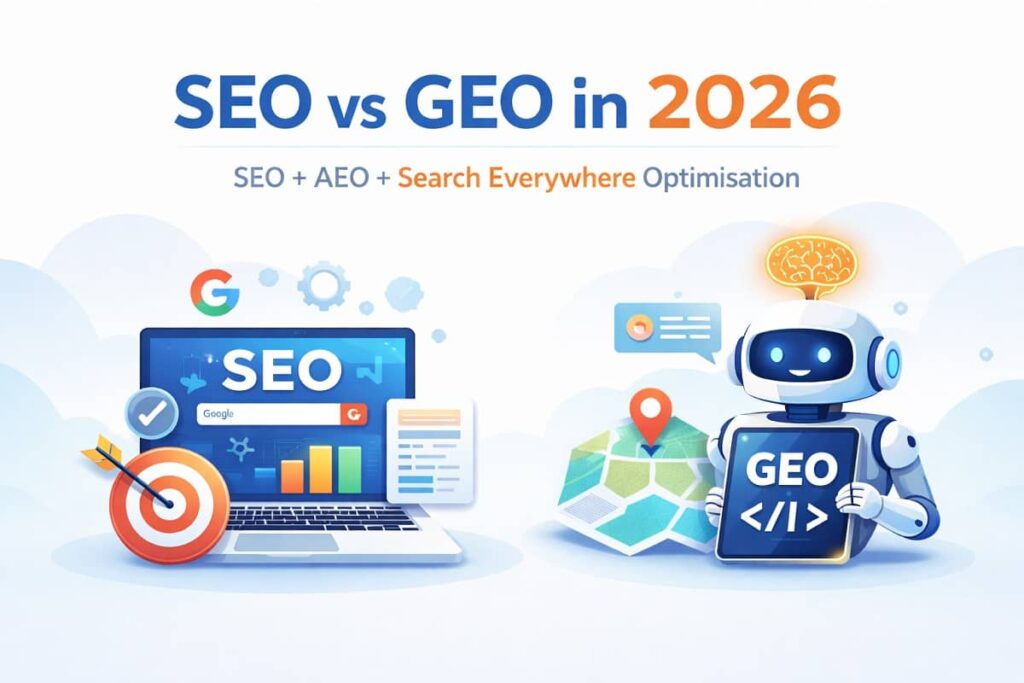
SEO vs GEO in 2026: SEO + AEO + Search Everywhere Optimisation
Search is no longer one place. People still use Google, but they also use AI answers (like Google AI Overviews, ChatGPT, and Perplexity), Maps, YouTube, and social platforms to discover and compare options. That’s why “SEO vs GEO” is no longer the right question.
In 2026, a practical approach looks like this:
- SEO is the foundation: fast, crawlable, trustworthy pages.
- AEO (sometimes called GEO/LLMO) is about getting a brand mentioned or cited inside AI answers – not only ranking blue links.
- Search Everywhere Optimisation extends visibility to the platforms customers actually use (Google, AI answers, Maps, YouTube, and social search).
Why this matters: AI features are now a real part of everyday search, so “ranking on Google” is only one part of how people discover and choose brands today.
- How users search in 2026: traditional search vs AI answers
- What is GEO, really? And how is it different from AEO?
- Search Everywhere Optimisation: the umbrella strategy
- SEO vs GEO / AEO vs Search Everywhere: quick comparison
- What to do in 2026: a practical playbook
- Is "classic SEO" becoming less sought after?
- Frequently asked questions
- Applying this to a website
How users search in 2026: traditional search vs AI answers
What happens in traditional search (SEO)?
In classic search, people scan a results page, click a few results, compare, and decide. SEO helps a page earn those clicks by matching intent, building trust, and delivering a fast, helpful experience.
Traditional SEO still works because it solves the basics:
- Can search engines crawl and understand the page?
- Does the page answer the query better than alternatives?
- Does it look trustworthy enough to deserve the click?
- Does it convert after the click?
What happens in AI search (AEO/GEO)?
In AI answers, people often ask longer, more specific questions and then follow up immediately. Instead of choosing from a list of links, they get a summary and a smaller set of sources that the system considers useful and reliable.
That changes the goal:
- SEO goal: rank pages and win clicks.
- AEO/GEO goal: become one of the sources AI systems choose to reference (even when the user doesn’t click).
The practical takeaway
SEO fundamentals still matter, but modern visibility also depends on content that is easy to extract, quote, and verify – plus consistent presence in the channels where customers already search.
What is GEO, really? And how is it different from AEO?
Several terms are used for “AI visibility” and they often overlap:
- AEO (Answer Engine Optimization): a practical marketing term for being present in answer-style results.
- GEO (Generative Engine Optimization): often used in research and newer tooling to describe improving visibility in generative systems. Read more about GEO.
- LLMO (Large Language Model Optimization): a narrower term focused on how large language models interpret and reuse information.
In practice, these ideas point to the same outcome: increasing the likelihood that a brand’s content becomes a trusted source for AI-generated answers.
A simple way to think about it:
- Use SEO to earn rankings and clicks.
- Use AEO/GEO to earn mentions and citations inside AI answers.
- Use Search Everywhere Optimisation to ensure visibility across the platforms customers use.
Search Everywhere Optimisation: the umbrella strategy
Search Everywhere Optimisation means stopping the assumption that Google is the only discovery channel.
Instead, visibility is built across the surfaces that matter for a specific audience, for example:
- Traditional search (Google/Bing)
- AI answers (AI Overviews, ChatGPT, Perplexity, etc.)
- Maps and local discovery
- Video search (YouTube)
- Social search (TikTok/Instagram)
- Communities and directories (when relevant)
Important: this does not mean “be everywhere“.
It means: choose the few platforms that actually influence customers in a niche, then show up consistently and helpfully there.
SEO vs GEO / AEO vs Search Everywhere: quick comparison
| Approach | Primary goal | What winning looks like | Best for |
|---|---|---|---|
| SEO | Rankings + clicks | More qualified organic traffic and conversions | Most businesses |
| AEO (GEO/LLMO) | Mentions/citations in AI answers | Being referenced as a source when AI summarizes the topic | Topics with lots of question-based searches |
| Search Everywhere Optimisation | Visibility across platforms | Customers find the brand across search, AI, maps, video, and social | Brands that want resilience and wider demand capture |
What to do in 2026: a practical playbook
1) Keep the foundation strong (still non-negotiable)
If a site is slow, messy, or hard to crawl, it struggles everywhere – including AI systems.
Priority basics:
- Technical SEO: crawlability, indexing, internal linking, clean architecture
- Performance and usability: especially on mobile
- Clear structure: headings, sections, summaries, and scannable formatting
- Structured data (schema) where it supports understanding (e.g., Organization, LocalBusiness, FAQs when appropriate)
2) Write for “answer extraction”
AI answers often pull information from pages that are easy to interpret and quote. Even in traditional search, users prefer pages that get to the point.
Practical improvements:
- Put a short, direct answer near the top of important pages
- Use headings that match real questions
- Include lists, steps, checklists, and comparisons
- Add “key takeaways” sections for longer content
- Make claims verifiable (examples, evidence, clear context)
- Keep pages fresh: update timestamps, improve older sections, add missing context
3) Strengthen credibility signals
Being chosen as a source (by humans or machines) depends on trust.
Signals that help:
- Clear authorship and experience (real background, real work)
- Consistent brand information across the site and across the web
- Helpful “about” and “contact” details
- Mentions and references in relevant, trustworthy places
- Reviews and local trust signals for location-based businesses
4) Choose 2–3 “search surfaces” beyond Google
The most common mistake is trying to do everything at once.
A better approach: pick 2–3 channels that match customer behavior.
Examples:
- Local services: Maps presence + reviews + local pages
- Visual niches: YouTube + short-form video + before/after proof
- B2B: LinkedIn + thought leadership + comparison pages
- E-commerce: product content + review ecosystems + shopping platforms
5) Measure outcomes, not vanity metrics
Rankings still matter, but they do not tell the whole story anymore.
Useful metrics to track:
- Organic conversions (leads/sales)
- Assisted conversions (organic starts the journey; conversion happens later)
- Branded search growth (a strong sign of demand)
- Content performance by intent (informational vs commercial)
- Local visibility trends (for local businesses)
- AI visibility checks (mentions/citations for priority topics, where possible)
Is “classic SEO” becoming less sought after?
The term “SEO” will likely remain the main label people use to buy this category – because it’s familiar.
What is changing is the scope clients expect:
- Rankings alone are not enough.
- Visibility needs to include AI answers and other discovery channels.
- The service needs to connect to business outcomes (leads, sales, qualified traffic).
In 2026, the strongest offer is not “SEO tasks”.
It’s a visibility system:
- SEO foundation
- AEO/GEO layer for AI answers
- Search Everywhere distribution where the audience already searches
The shift is from “rankings” to “being found and chosen”.
Frequently asked questions
Should the term be GEO or AEO?
AEO is usually easier to explain to clients and readers. GEO and LLMO can be mentioned as alternative names, but leading with AEO keeps the message clear.
Will AI answers reduce organic clicks?
For some searches, yes. That’s why mentions/citations and multi-surface visibility matter more than ever. Brands that only optimize for clicks may miss customers who never leave the results page.
Does every business need Search Everywhere Optimisation?
Not in the “every platform” sense. The goal is not to chase trends; it is to choose the platforms that influence customers in a niche and build consistent visibility there.
What should be done first?
Start with foundation (technical, speed, structure) and update the most important money pages so they are clear, helpful, and easy to quote. Then expand to the channels that match the audience.
Applying this to a website
The safest sequence for most businesses:
1) Fix crawlability, indexing issues, and obvious performance problems
2) Improve key landing pages (services/products) for clarity and conversion
3) Build supporting content that answers real questions
4) Strengthen local/brand presence and trust signals
5) Expand to 2–3 additional search surfaces (video/social/maps) where it makes sense
6) Measure outcomes and iterate monthly
Want a practical implementation plan?
See our SEO + Search Everywhere Optimisation service here:
https://www.omo.hr/services/seo/
Future-proof your online visibility and drive more traffic, leads, and revenue in 2026 and beyond. Let’s Talk.
